Tuesday, September 20, 2011

Harley and me

Please note: James' blog has moved to a Wordpress site. To access it, please visit http://jameswiebe.wordpress.com/. All posts have been transferred to the new site, and all new posts will only be accessible via Wordpress. Thank you for your interest!


The air temperature had settled to about 82 or 83 degrees.  This felt comfortable; especially in comparison to the brutal days of our earlier summer.  And after rolling down the grass runway and leaving the ground, the air aloft was even gentler and cooler.  And the air was calm.

I was catching a ride in an old friend, and it was a privilege to be a guest in the airplane we've known as 'Harley':

Ultralight Aircraft from Belite Aircraft

The takeoff roll was a little long; a lack of headwind was to blame.  Maybe some of my 200 pounds contributed to the longer roll as well.  Even so, I was able to join along for a comfortable rate of climb.

I noted that the pond off the far end of the runway is still very parched for rain.  A turtle slapped around in the shallows.  I wonder if any fish are living there.  Also, I haven't seen any deer drinking there since last fall.  What will this fall bring?  Harley wondered as well.

A tractor and bailer attachment were ignominiously parked in the middle of a field nearby.  The field offered a helpful place for an off-field landing, should the need arise.  But Harley didn't need it, never had.

The plane turned itself towards the North; I just followed along on the controls.  I was the guest.  A row of cedar pines, very scruffy looking, protected the eastern side of our gliderport, and I was able to greet them and remind them of the presence of the orange and black airplane in which I comfortably sat.  With no wind on the ground, they didn't wave branches to me, but we still saw each other, and we both knew of the special nature of the flight.

The northern field had been plowed; I ignored the horse ranch to the northeast of our field.  The Harley knows that we don't like to fly low and slow over the horse ranches;  I remember the story of (some other) ultralight flying over them and bucking a woman off a horse.  The plane and I respect the horses.  If we choose to fly over them, we seek a respectful altitude first.

A turn towards the runway, and then an overflight of a small group of people who have assembled to take a tour of the Belite facility.  Ostensibly, I am flying as a demonstration for them, but really, Harley is flying as a demonstration for me.

Then a nice turn over the people, and then Harley scoots for a low pass besides some trees on the opposite side of the runway.  Chasing rabbits -- imaginary, very large, very slow rabbits.

This plane was in our 'inventory' for about two years.  I have no idea why.  It was (and is) beautiful.  Nobody wanted it, because it wasn't exactly what they wanted, or we wanted too much money, or something...

Except a few people did want it.

We sold this plane at least twice; one prospective owner changed his mind on buying it after sending in the deposit money.

Harley was down-hearted after hearing that news -- pretty much like the dog left perpetually out at night or the orphan rejected by potential parents, who maybe smiled at the child in a meaningful way, yet lied in their heart at the same time.  Harley developed a sticking set of rings as a result, just like people with emotional pain who develop physical ailments.  My shop manager, Gene, helped diagnose the ring problem and I happily ordered a new set of rings and gaskets from the engine hospital.  No big deal.  Harley was fixed.

One time, Harley had shown me how to do dead stick landings.  I remembered that very well, and you can see it again by clicking on this old post.


Deadstick landing in Ultralight Aircraft

Harley also had suffered from a serious case of ugly cowl syndrome; we'd flown him without a cowl (a long time ago) and also with an aluminum 'bib cowl'.  Although the bib cowl shined up nicely, Harley was always a little embarrased with the bib cowl.  He wanted to be with our other airplanes, the ones with real fiberglass cowls and bumps where the pistons are supposed to be.

I went through a box of his child photos.  I found one of Harley with his bib cowl.:

Utralight Aircraft with Aluminum Cowl
Back then, he had carbon fiber struts (long removed); spring landing gear (still work *awesome*); a full paint job; and a very nice basic panel.  He was long on good manners, both on the ground and in the air, and always managed a smile.

I also found some photos of him playing in the sky:

Harley flying


Harley climbs


Utralight Aircraft in Right Turn

But I'm still flying as Harley's guest.

I ask Harley if I can land, and he agrees.

We turn together toward our grass strip.  I crank in one notch of flaps, and reduce power.  Harley comes in over fence.  I add a second notch of flaps, and reduce power further.

Harley is just over the grass, with nose just high, and a moment later the wheels barely touch down.  No bounce, no jostle.  A moment later, we pull toward the tour group, and the demo flight is over.  Harley sat proudly in the middle of a group of children and Big Brothers / Big Sisters of Sedgwick county, and he helped me answer question after question about ultralight aircraft and how we build them.

After helping Harley get back in the hangar for the night, I chocked one of his wheels and headed over to the assembly room to see how Harley was built.

Harley was left with wings extended, sitting in a hangar with Cessna 182's, gliders, and other Belite parts.  He was very happy to be in the main hangar, and he was important, just as important as the Cessna 182.

Even more important to a gentleman who wanted to fly Harley and help them rediscover their mutual love for flying.

Tomorrow morning, Harley's new owner gets to sit in Harley for the first time.  He has arrived from the east coast to see and take ownership of Harley.

Harley was sold for about $14,000.  Harley was promotionally priced because we wanted to reduce our inventory of steel fuselage airplanes as we bring our larger and lighter aluminum fuselage production online.

BTW, Harley also has a new orange fiberglass cowl.  The alumimum bib skin is gone.

From our Facebook:

Fun fact: Flying our Harley airplane will make you feel rugged and fearless, just like the motorcycle it is named after.

That wasn't true.  But this is true:

Fun fact: Flying our Harley airplane will make you feel that flying is one of the greatest gifts and privileges that God gave us. 

Monday, September 19, 2011

Aluminum skin for Aluminum Ultralight Aircraft

The CNC cut aluminum skin for the top of the rear fuselage of our aluminum ultralight aircraft was ready to install today.  The entire weight of the top skin is less than 1.5 pounds!

It didn't take long, and it was clecoed in place.  It still needs quite a bit of work, but it is sure fun to look at.

The front compartment is for the fuel tank and baggage, and has a square cutout with radiused corners.  The rear sections are cut out with ellipses to save weight.

Enjoy the picture of work in progress:  (Sharp eyes may notice other interesting things in the room...)


Sunday, September 18, 2011

Ultralight Aircraft for disabled pilot

A Belite customer challenged us to improve cockpit access for our Belite ultralight aircraft; the customer has some challenges; especially with his legs.  Getting in and out of our aircraft is a real challenge.

As a result, we were pleased to improve cockpit access by lowering the fuselage right side door height.  We cut off the existing steel tube and welded a tube about 5 inches lower; with additional length on the tube to add strength.

Here's a photo:  compare the near and far sides of the fuselage to see the difference in the steel structure.  You can see that the nearer side has a lower entry level. 


Wednesday, September 7, 2011

Aluminum Plane: Real Flight Data Graph

One of the joys of this project is the performance of the product:  the aluminum plane rocks.

Here is a "GPS Essentials" flight data chart from a recent flight in Aluminum Plane #1:

Belite Ultralight Aircraft Performance Graph
I marked two locations with yellow dots.  The difference between these dots in time is about 3 minutes, and the altitude gain is (2070-1500) = 570 feet.  This is a calculated climb rate of 225 feet per minute.  With a forward airspeed of about 43 mph in the climb, the actual climb angle was about 5 degrees, and the deck angle was probably around 12 degrees.  Climb rate was NOT maximum.  (although it was probably close).  I weigh 200 pounds, plus some gas on board of course, and density altitude was about 3300 feet at ground elevation.

All this with a tiny 28hp engine.

You can also see some two pass runs, demonstrating cruise speed.  With the wind, ground speed averaged about 64mph and into the wind, ground speed was 47mph.  The average is 55.5 mph, once again, with a 28hp Hirth F33 engine.

Fun, fun, fun!

- James

Tuesday, September 6, 2011

"This Belite Be No More"

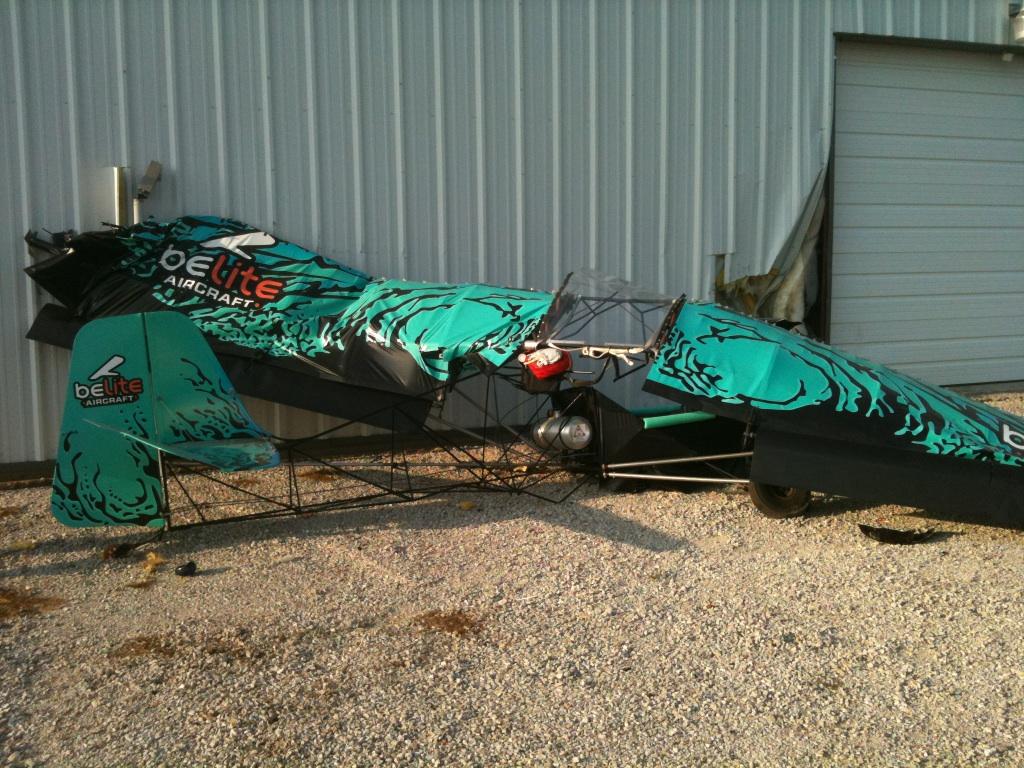
And this is a very sad story, with one fantastic testimony to the crash worthiness of our airplane.

The 80+ year old pilot was observed to take off in the Belite Superlite, barely gaining enough altitude to clear a fence.  Apparently, the pilot did not command the airplane to turn in any direction, climb, or descend back to the ground, which was just a few feet below him.  Nor did he retard the throttle, which was reported at 'full' by an observer.  (The Superlite is capable of climbing out at fairly steep angles.)

After continuing in this manner for a handful of seconds, he crashed into the side of a distant steel building, still under full power, still just a few feet above the ground.  I have not seen the accident in person, but I do have one photograph.  It seems to show a very hard impact of the left wing tip, then impact of the main structure of the fuselage.  The wing ribs and spars are carbon fiber, and the fuselage is chromaloy steel -- all very tough stuff.

The pilot was wearing his seat belt / shoulder harness, and escaped the accident with broken ribs.  The cabin structure of the Belite, along with the safety harness, probably saved his life.

The metal gas can did not rupture.  (It is optional equipment.)  The parachute did deploy at impact (probably due to stretching of the release cable in the accident.)

We are very saddened by this accident and wish the pilot a speedy and full recovery.

Belite Ultralight Aircraft Accident

More Info: Ultralight Aircraft Aluminum Fuselage

The #2 Aluminum rear fuselage is taking shape nicely.  This particular aircraft is destined to be a tricycle gear airplane.

Everything you see here is weighing in at about 33 pounds, including tricycle mods.  I am pleased.  We had taken a 'weight bump' but have gotten some of the weight back out by trimming excess off cross members.

We're waiting to mate this fuselage with carbon fiber spar wings; we're currently out of stock on the carbon fiber and waiting for a shipment to come in.  As a result, the fuselage will not be flying until around Thanksgiving.  It is scheduled to deliver to a customer in December.

Please note the gas tank / cargo compartment.  It's designed to hold a 5 gallon plastic tank, for easy swapping.

The purpose of the side aluminum sheet panels is to spread landing gear loads from the gear into the fuselage.

It would be very easy to 'metalize' this entire airplane.  I hope some customer chooses to do that.


Belite's Ultralight Aircraft Aluminum Fuselage

Close up of gas compartment.  Optional lid over this, along with panels to close off the compartment.

Detail of tail section.

Tail Section, another view.

Belite's Aluminum Ultralight Aircraft fuselage

Thursday, August 25, 2011

Phenomenal Performance from Yellow Aluminum Ultralight

You'll get three things from this post:

a)  I can't stop glowing over the phenomenal experience I had flying our aluminum prototype airplane.  It was configured with a 28HP engine and the performance was very close to what we've experienced with our 50HP airplanes.  The reasons why this all worked:  light aluminum construction, a big wing with an awesome low speed coefficient of lift, (bigger span, bigger chord), bigger flaperons, and the exact right prop/engine combination.  I took a GPS chart on my phone of the flight and will try and figure out how to post it.

b)  I can't stop glowing over the phenomenal experience I had while practicing off-field landings in the next door hay field -- my able assistant Gene captured the STOL landing to perfection.  I cranked in two notches of flaps and nailed the touchdown spot within 15 feet.  After rolling to a stop (and I didn't use maximum braking), position was noted. Gene and I went and measured the touchdown roll with our tape -- 100.5 feet (that's 100 and one-half foot) from touchdown to stop.  The landing was made full stall (and was nearly full STOL, for those that grok the difference) and the plane dumped onto the hay from about a foot or two off the ground.  The steel spring gear just absorbed it all, you can see the tailwheel disappear into the grass in one of the pics that Gene took, and nuthin' bent.  Just saying.    Oh My what fun ------ Steve you will like your plane.

c)  The plane is really pretty.

That's three things.  Here's picture proof.  Let's start off with three pictures of the plane just flying around.

Belite's Aluminum Ultralight Aircraft flying overhead

Belite's aluminum ultralight aircraft

Belite's aluminum Ultralight Aircraft, passing under the sun

Now let's look at that landing sequence, showing short final into the hay field with the 100 foot stop:

Belite's aluminum ultralight aircraft, short final to the hay

Belite's aluminum ultralight aircraft, short final abeam the trees

Belite's aluminum ultralight aircraft, closer to the hay

Belite's aluminum ultralight aircraft, 25 feet up

Touchdown!

Smack that tail down

Rolling through the hay

Already stopped!!!  Turning

Yeah Gene, I did it.  :-)  Nothing broke. 

One final pic after I taxiied back around the field and up the runway..

Pretty Plane, Awesome Performance, I like it...

Wednesday, August 24, 2011

Service Bulletin 8-24: Rod End Bearing needs cap washers

We had a partial failure on a rod end bearing, on a lift strut.  The point of failure is where the lift struts attach to the fuselage.  The internal structure of the rod end bearing began to fail, and as a result, the rod end bearing might have slipped over the head of the bolt.   If this had happened, there is a strong possibility that the lift strut might have detached from the bearing bolt on the fuselage, with damaging or catastrophic results.  A simple solution is the addition of a cap washer.  We recommend immediately adding these washers to your aircraft before further flight.  It is important that the top washer is trimmed so that it does not hit or rub the lift strut. 

Failed Lift Strut Rod End Bearing

Another view of Failed Rod End Bearing
In order to prevent these rod end bearings from slipping over the head of the bolt, we are installing cap washers:

Cap Washers, with one trimmed
Here is a photo of the reassembled lift strut attach point, showing the rod end bearings and the cap washers.:

Cap Washers installed on lift strut


The bolt has been reinstalled, complete with quik release key (safety wire is of course also acceptable).

If you need these washers, please contact us and we will supply them at no charge.

The integrity of the rod end bearings should be inspected with each preflight.