Editor's Note:
I recently returned from a heavy work schedule and from a great Alaskan vacation!
My last post was an excellent article by Earl Downs on the Belite. It provided a great view of the flying qualities of the Belite.
Many people want to know how to transition to flying a single place ultralight airplane, such as our Belite. This particular post will help you gain that knowledge! Although originally written years ago by another author, I have been graciously granted (anonymous) permission to update it to reflect our Belite ultralight aircraft.
Enjoy the reading.... Enjoy the learning... and enjoy the flying!
Published in three parts
Flying the Belite Ultralight Aircraft - Part 1
by James Wiebe, CEO
Belite Aircraft
General Flight Characteristics
The Belite 254 / Superlite / Trike (hereafter, collectively referred to simply as: 'Belite') is first and foremost, a very real airplane, requiring competent flying skills to takeoff, fly and land. In return, it offers a genuine flight experience, with none of the compromises associated with traditional ultralight aircraft and FAR Part 103 legal designs.
Most of the takeoff and landing comments below refer to the taildragger versions -- the Trike version is even easier to land.
The Belite utilizes a standard three axis flight control system consisting of flaperons (ailerons that also act as adjustable flaps, through the use of an ingenious flap / aileron mixer). It also has a conventional elevator and rudder.
The ailerons and elevator are operated by a conventional control stick, while the rudder are moved through the use of independent rudder peddles. Any pilot familiar with aircraft such as a standard Kitfox, Piper Cub (or common derivatives, such as the CubCrafter), or Aeronca Champ will find the cockpit to be a familiar and friendly environment. The flap function is provided by a four position flap lever that intermixes with the aileron control to 'droop' the flaperons.
Additionally, independent mechanical heel brakes are used to both stop and steer the Belite during ground operations. An optional electric elevator inflight trim system provides for completely neutral flight characteristics during cruise, allowing hands off operation for brief periods of time, such as when taking photographs. Back pressure is used on the stick in order to maintain a normal approach speed. All flight controls are lite and very responsive at all speeds.
(For an independent extensive flight review of the Belite, see the excellent article by Scott Severen, published elsewhere on this blog.)
The tail-wheel configuration of the Belite does not present any unusual challenges during takeoff or landing. The large rudder is very effective and little, if any, differential braking is needed to control the landing rollout. In fact, customers preferring to fly their aircraft without brakes will be comfortable, especially when operating off of grass airstrips with light crosswinds.
Absolutely no differential braking is needed on the takeoff roll due to excellent rudder effectiveness. Basic tail-wheel training in a Kitfox, Cub, Champ, Cessna 120/140, Citabria, or other tail-wheel light aircraft should serve to prepare you to handle the Belite. Differential braking works well to steer the Belite during tax and forward visibility on the ground is unrestricted. 'S' turns are generally unnecessary.
As with the operation of all airplanes, the pilot should be current and qualified. You should not attempt to fly the Belite unless you would feel absolutely comfortable soloing the airplane you have been flying for tail wheel proficiency. The EAA can provide help with transition instruction in a taildragger and with 'first flight' issues. You are encouraged to secure as many resources as possible to help with your transition.
Ground Handling
The Belite utilizes differential heel braking to maneuver the airplane. The heel brakes will cause the airplane to turn in the direction in which force is applied; left braking makes the plane turn left; right braking makes the plane turn right; braking both sides causes the plane to slow down.
Do not try to turn the airplane from a dead stop by locking a wheel and then adding power. The airplane will turn much more easily if the plane starts moving slowly first, then applying braking to the appropriate side. Once a turn is started, the momentum of the turn will tend to keep the turn going. Once you are taxiing, the rudder alone may be all that is needed to steer your Belite. As with all tail wheel airplanes, it is a good idea to center the tail wheel when you come to a stop. This practice will make it much easier to control when you start taxiing again, or when you start your takeoff roll.
There may be circumstances when taxiing in tall grass or on a soft surface that make it difficult to swing the tail when differential braking is applied. There is an old trick from the day of tailskids that may help out. If the tail wheel is really bogging down, add sufficient power to get the plane moving, then push the control stick forward (keeping the power up) and then apply brake and full rudder in the direction you wish to turn. The forward stick will lighten the load on the tail wheel and the rudder will help push the tail around. Be very careful when trying this, as you could blow a lot of dirt around or upset airplanes behind you. Always be courteous to other airplanes and pilots.
A note of caution: one must be very cautious when taxiing in windy conditions. The light weight and low wing loading of the Belite makes it susceptible to being upset by ground winds. Unless you have exception skills, fully understand the risks, and (perhaps) have wing walkers available, do not taxi your Belite in winds exceeding 12 knots (15 mph) or greater. Rapid ground turns should be avoided under all conditions.
Like any airplane, appropriate taxiing technique is important. The flight controls can be quite effective in helping the Belite ultralight aircraft safely taxi. When taxiing into a headwind, hold the control stick full back to help keep the tail on the ground. A tailwind requires to the stick full forward; this will help keep the tail on the ground. With the quartering headwind, move the control stick into the wind, as if trying to turn into the wind. With a quartering tailwind, move and hold the control stick away from the wind, as if trying to turn away from the wind. If the wind is straight over the nose or tail, keep the ailerons centered. These positions will help keep the wing from being lifted by the wind.
You should be completely comfortable with taxiing, braking, and turning before proceeding to takeoff. I say again: have total comfort with ground handling and taxi operations before proceeding to takeoff.
Take Off
Your first takeoff should be made from a runway that is both wide enough and long enough to accommodate errors. It should also be made from a runway without pressure from other aircraft operations. Do not make your first takeoff with space restrictions that require maximum performance. Perform a thorough preflight; make sure that the engine is warmed up and is showing correct temperatures, RPMs, mag checks, etc.
Align your Belite on the centerline of the runway and make sure the tail wheel is centered. With the brakes locked and control stick held fully back, smoothly increase the power to approximately 75% of full power. Release the brakes and continue to smoothly increase power to full throttle. You will immediately see that the rudder is fully effective; you can control direction by use of the rudder pedals. You won't need to use the brakes. Keep the ailerons (flaperons) centered. Directional control on the ground is controlled by your feet, not your hands.
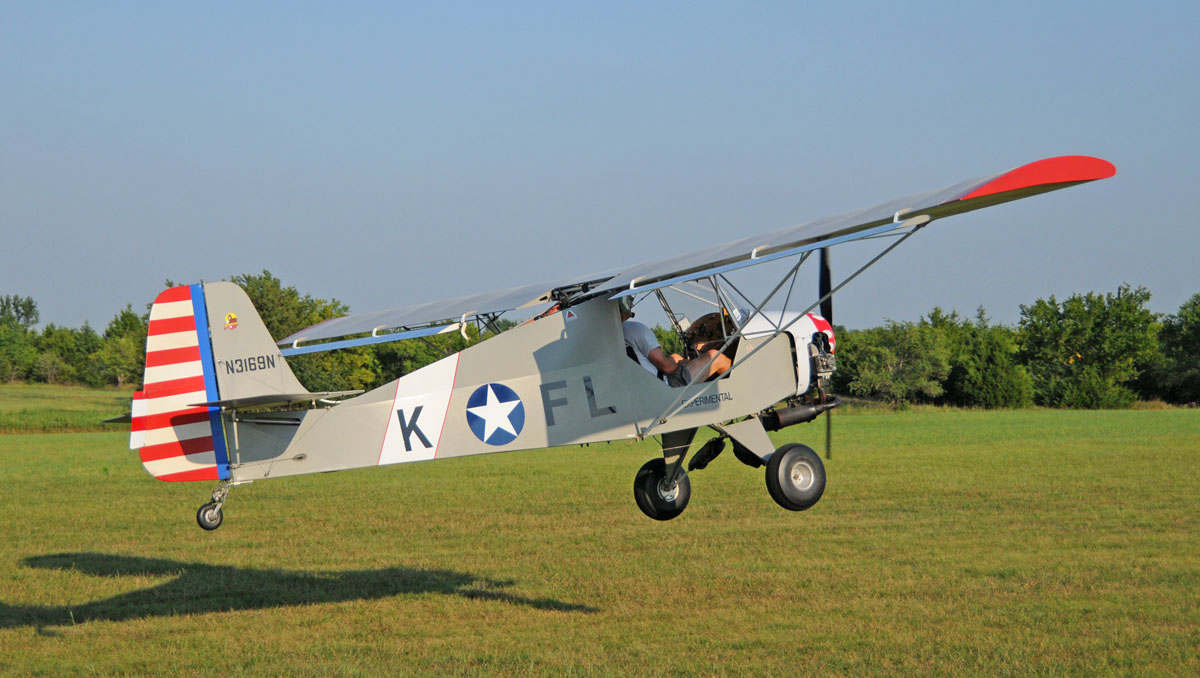
Shortly after applying full power, you can push forward on the stick, and the tail will raise off the ground into a traditional level attitude. Keep the nose straight (using the rudder pedals), and as the speed passes 40 to 45mph, you'll be able to pull the stick back a little, and the airplane will fly. Depending on engine power, the total time from brake release to liftoff is about 5 or 6 seconds, depending on field elevation, winds, temperature, aircraft weight, and engine selection. In a strong breeze, a takeoff roll of well less than 100 feet is an easy matter.
Immediately at and after liftoff, the flaperons become very important. You'll use the control stick to level the wings. Concentrate on level wings and a slight climb attitude. I enjoy climbing to the top of ground effect (about 30 feet off the ground), then briefly leveling off and continuing climbout at a stabilized Vy speed, which is about 50mph.
As you gain more experience with the thoroughly enjoyable takeoff characteristics of the Belite, you will find that it also takes off very well in a three point attitude. The basic procedure is the same, but instead of pushing the control stick forward, you simply place the stick in a centered, neutral position. The Belite will fly off the ground when it is ready, in a tail low attitude. Make appropriate minor pitch adjustments as required to establish a climb.
Don't climb out too rapidly -- never climb out below Vx (about 40mph); if your density altitude is high, or your weight is heavy, your climbout speed should be at Vy or higher. Remember, you are flying the airplane.
Continue to Part 2 by clicking here

"The Standard Pilot Blog"TM The Chipper and Radiant Blog for Experimental and Ultralight (Part 103) Aircraft (c) 2010 thru (c) 2020 by James Wiebe.
Wednesday, September 15, 2010

Thursday, September 2, 2010
What's an ATP Like Me Doing In a Belite?? By Earl Downs
Editor's Note: I've gotten to know Earl Downs, who used to help Skystar show and sell their Kitfox aircraft. (Earl's brother Ed was President of Skystar, maker of the original Kitfox Lite.) Recently, Earl had an opportunity fly both our ultralight aircraft Superlite Dragon, and our ultralight aircraft tricycle gear Belite, AKA the Trike.
Earl has authored over 80 articles for various publications, including Sport Pilot, Sport Aviation, and other magazines. Earl has written the following article for Belite, and I'm pleased to publish it here.
"What's an ATP Like Me Doing In a Belite??"
A Guest Blogpost for Belite Aircraft By Earl Downs
That’s right, I’ve been flying for 54 years and earned my airline transport pilot certificate 41 years ago. I’m still actively flying and flight instructing in all kinds of airplanes. So, it’s logical to ask, “Why is a licensed pilot like me flying an ultralight that does not even require the pilot to be certificated?” The simple answer is; I like the Belite because it’s fun and exciting to fly.
As it happens, I didn’t always have a passion for the ultralight style airplanes. When the ultralights first appeared in the late 1970s, I was one of those guys that said, “You must be crazy.” At that time, I was the manager of Boeing 707 and 727 pilot ground training for a large airline. However, when FAR 103 (the ultralight rules) was published in the early 1980s I was a little curious because the FAA was now involved.
In 1981 a couple of airline pilot friends of mine bought an MX II Quicksilver kit (that’s an ultralight style 2-place airplane) and built the plane under experimental-amateur built certification. I took them up on an offer to fly it and found a new way to “hang in the sky.” The early MX II did not fly much like a “real airplane,” but I got the hang of it and enjoyed it until the owners went their own ways and the MX II moved to another location. I wasn’t with the MX II for very long, but it changed my attitude about ultralight flying.
I was away from ultralights for about 15 years until I saw the KitFox Lite. It was an ultralight, but it had all the characteristics of a “real airplane.” I bought a kit in June of 2000 and it was flying in the spring of 2001. I loved my Lite! I found the controls harmonized perfectly; it flew with a light touch but was not “twitchy.” I cut a deal to lease my Lite to KitFox for use at airshows, and I would join their team to do the demo flying. I even found room for a 400 foot airstrip (Horse Apple Airfield) on my 10 acre homestead for backyard flying.
A few years ago I sold my Lite to move on to another project, and I was saddened when KitFox removed the Lite from their product line. Then, I heard that a guy in Wichita, Kansas had picked up the tooling and was going to produce the Lite again, under a new name, and with new improvements. As it turned out, James Wiebe not only had the tooling, he also had a background in a technology that could take this already proven ultralight in a new direction.
If the KitFox Lite had one challenge, it was to keep it light enough to meet the ultralight requirements of FAR 103. James’ unique expertise is in the area of lightweight composite materials, and he knew that carbon fiber was a key to opening up ways to bring more choices to the ultralight pilot. James formed the Belite Aircraft Company and used carbon fiber to expand the capabilities of an ultralight now named the Belite. New engine choices and construction features allow the Belite to be tailored to what the customer wants.
James invited to me fly a couple of his Belite airplanes, and I jumped at the chance to see what his company had done to my favorite airplane. A 2-hour 45-minute drive from my home in Cushing, Oklahoma led me to the production location on the northeast side of Wichita. The 2,600 foot long turf runway in the Kansas countryside is the perfect location for fun flying.
The first airplane I flew is the hotrod they call, “The Superlite Dragon.” (The paint scheme was inspired by dragons from the movie AVATAR -- Editors Note)
Equipped with a 50 HP Hirth twin cylinder, dual ignition engine, it still meets the FAR 103 requirements because of its use of weight-saving carbon fiber. Flying it was like flying my beloved KitFox Lite on steroids! Just like I remembered, the light controls were in perfect balance, but the short takeoff and rapid climb far exceeded that of my Lite. An experienced pilot will feel right at home in this ultralight hotrod, and a new pilot will find that a first flight in this little single-place plane is exciting but not intimidating. Even though it’s a taildragger, anyone with a few hours in a Cub or Champ will find it docile on the ground and in the takeoff and landing phases of flight.
The next plane I flew was the tricycle landing gear version of the beLite with the smaller 28 HP Hirth engine. To be honest, I expected the performance to be a bit “wimpy,” but I was pleasantly surprised. It demonstrated what I call, “good ultralight performance” combined with the excellent controllability of a “real airplane.”
Of course, the forward visibility on the ground is excellent and the takeoffs and landings are a typical tricycle gear non event. For pilots intimidated by taildraggers, it provides a better option with perfect ground and landing manners. It is also available with a larger engine.
The KitFox Light broke the code when it came to an ultralight that had the handling qualities of traditional airplanes. Through the use of modern technologies, the Belite Aircraft Company has expanded the versatility and capability of this captivating little airplane. All of this adds up to more flying for fun.
-- Earl Downs
Earl has authored over 80 articles for various publications, including Sport Pilot, Sport Aviation, and other magazines. Earl has written the following article for Belite, and I'm pleased to publish it here.
"What's an ATP Like Me Doing In a Belite??"
A Guest Blogpost for Belite Aircraft By Earl Downs
 |
| Earl Downs, in Baby Ace |
As it happens, I didn’t always have a passion for the ultralight style airplanes. When the ultralights first appeared in the late 1970s, I was one of those guys that said, “You must be crazy.” At that time, I was the manager of Boeing 707 and 727 pilot ground training for a large airline. However, when FAR 103 (the ultralight rules) was published in the early 1980s I was a little curious because the FAA was now involved.
In 1981 a couple of airline pilot friends of mine bought an MX II Quicksilver kit (that’s an ultralight style 2-place airplane) and built the plane under experimental-amateur built certification. I took them up on an offer to fly it and found a new way to “hang in the sky.” The early MX II did not fly much like a “real airplane,” but I got the hang of it and enjoyed it until the owners went their own ways and the MX II moved to another location. I wasn’t with the MX II for very long, but it changed my attitude about ultralight flying.
I was away from ultralights for about 15 years until I saw the KitFox Lite. It was an ultralight, but it had all the characteristics of a “real airplane.” I bought a kit in June of 2000 and it was flying in the spring of 2001. I loved my Lite! I found the controls harmonized perfectly; it flew with a light touch but was not “twitchy.” I cut a deal to lease my Lite to KitFox for use at airshows, and I would join their team to do the demo flying. I even found room for a 400 foot airstrip (Horse Apple Airfield) on my 10 acre homestead for backyard flying.
 |
| Earl Downs in his Kitfox Lite at Horse Apple Airfield -- 400 foot strip! |
A few years ago I sold my Lite to move on to another project, and I was saddened when KitFox removed the Lite from their product line. Then, I heard that a guy in Wichita, Kansas had picked up the tooling and was going to produce the Lite again, under a new name, and with new improvements. As it turned out, James Wiebe not only had the tooling, he also had a background in a technology that could take this already proven ultralight in a new direction.
If the KitFox Lite had one challenge, it was to keep it light enough to meet the ultralight requirements of FAR 103. James’ unique expertise is in the area of lightweight composite materials, and he knew that carbon fiber was a key to opening up ways to bring more choices to the ultralight pilot. James formed the Belite Aircraft Company and used carbon fiber to expand the capabilities of an ultralight now named the Belite. New engine choices and construction features allow the Belite to be tailored to what the customer wants.
James invited to me fly a couple of his Belite airplanes, and I jumped at the chance to see what his company had done to my favorite airplane. A 2-hour 45-minute drive from my home in Cushing, Oklahoma led me to the production location on the northeast side of Wichita. The 2,600 foot long turf runway in the Kansas countryside is the perfect location for fun flying.
The first airplane I flew is the hotrod they call, “The Superlite Dragon.” (The paint scheme was inspired by dragons from the movie AVATAR -- Editors Note)
 |
| Belite Superlite Dragon |
Equipped with a 50 HP Hirth twin cylinder, dual ignition engine, it still meets the FAR 103 requirements because of its use of weight-saving carbon fiber. Flying it was like flying my beloved KitFox Lite on steroids! Just like I remembered, the light controls were in perfect balance, but the short takeoff and rapid climb far exceeded that of my Lite. An experienced pilot will feel right at home in this ultralight hotrod, and a new pilot will find that a first flight in this little single-place plane is exciting but not intimidating. Even though it’s a taildragger, anyone with a few hours in a Cub or Champ will find it docile on the ground and in the takeoff and landing phases of flight.
The next plane I flew was the tricycle landing gear version of the beLite with the smaller 28 HP Hirth engine. To be honest, I expected the performance to be a bit “wimpy,” but I was pleasantly surprised. It demonstrated what I call, “good ultralight performance” combined with the excellent controllability of a “real airplane.”
 |
| Belite Trike Climbing Out |
The KitFox Light broke the code when it came to an ultralight that had the handling qualities of traditional airplanes. Through the use of modern technologies, the Belite Aircraft Company has expanded the versatility and capability of this captivating little airplane. All of this adds up to more flying for fun.
-- Earl Downs
Sunday, August 29, 2010
Another Saturday Breakfast Run
I enjoyed flying to Benton (Stearman Field) with Paul Fiebich for breakfast last Saturday. Great time! Here's some pics which Paul took of my yellow Belite Trike. I'll post some pics of Paul's airplane soon too.
And here's a pic that Paul took while I flew overhead. What was I doing? How was he holding the camera?
After Paul left, I did a quick two way run with my GPS in order to verify cruise speed. With a 28HP engine, this airplane trued at 56 mph. I thoroughly enjoy this plane. It's a very nice FAR Part 103 ultralight aircraft.
 |
| Belite Trike over nice house |
 |
| Belite on short final |
And here's a pic that Paul took while I flew overhead. What was I doing? How was he holding the camera?
 |
| Belite Fun Flying |
After Paul left, I did a quick two way run with my GPS in order to verify cruise speed. With a 28HP engine, this airplane trued at 56 mph. I thoroughly enjoy this plane. It's a very nice FAR Part 103 ultralight aircraft.
Tuesday, August 24, 2010
Stearman Field & the $100 Hamburger (make that a $1.50 hamburger)
Today's post is short and sweet -- just a little lunch time flying over to Stearman Field.
I can fly from my home base (Wichita Gliderport, home of Belite Aircraft) over to Stearman Field in about 5 minutes. As a result, it makes a great lunch destination, and I consume about a $1.50 of gas on the round trip in my ultralight aircraft. Awesome.
Stearman Field used to be Benton Airport. I paid it my first visit about 30 years ago, shortly after I got my private ticket and needed a plane to rent. It had a small dingy office, fuel for sale, and a mechanic somewhere in the shed in the back. The runway was lined with some homes.
That was then... today, Stearman Field is a busy place, with a new office/restaurant; an outdoor eating area, many new hangars, new homes, new runway extensions, instrument approach... the new owners have made a world of difference.
The restaurant is great -- providing a feel of flying nostalgia along with awesome greasy breakfasts and wonderful burgers for lunch. I've slipped in there several times in the last month. I managed to get over there before Oshkosh, and I had flown over in the yellow trike.

Here's a photo of the lunch counter, along with all the airplane nostalgia:

Nice, right?
Folks couldn't help but stop and look at the Cub Yellow Trike, and I took their pic from my dining table:

The Belite Trike is a great vehicle for taking in the local airstrips. It looks and flies like a real airplane, and it sure makes everyone stop and look at it.
You can read more about Stearman Field by clicking on this link.
You can read more about our Trike by clicking on this link.
Thank you, and enjoy your meal!
I can fly from my home base (Wichita Gliderport, home of Belite Aircraft) over to Stearman Field in about 5 minutes. As a result, it makes a great lunch destination, and I consume about a $1.50 of gas on the round trip in my ultralight aircraft. Awesome.
Stearman Field used to be Benton Airport. I paid it my first visit about 30 years ago, shortly after I got my private ticket and needed a plane to rent. It had a small dingy office, fuel for sale, and a mechanic somewhere in the shed in the back. The runway was lined with some homes.
That was then... today, Stearman Field is a busy place, with a new office/restaurant; an outdoor eating area, many new hangars, new homes, new runway extensions, instrument approach... the new owners have made a world of difference.
The restaurant is great -- providing a feel of flying nostalgia along with awesome greasy breakfasts and wonderful burgers for lunch. I've slipped in there several times in the last month. I managed to get over there before Oshkosh, and I had flown over in the yellow trike.

Here's a photo of the lunch counter, along with all the airplane nostalgia:

Nice, right?
Folks couldn't help but stop and look at the Cub Yellow Trike, and I took their pic from my dining table:

The Belite Trike is a great vehicle for taking in the local airstrips. It looks and flies like a real airplane, and it sure makes everyone stop and look at it.
You can read more about Stearman Field by clicking on this link.
You can read more about our Trike by clicking on this link.
Thank you, and enjoy your meal!
Monday, August 23, 2010
An Afternoon Flight with two Ultralight Aircraft
I gave Terry a call.
"Hi Terry,
I have to do a fuel consumption check on the Yellow Trike. If I fly over to your house, will you fly your Kitfox Lite and join me for some flying time?"
Terry answers:
"Yes, I have to check to see if the strip is mowed, but that should work fine."
I take off in my yellow Belite Trike and head over to Terry's strip, about a 20 minute flight to the east:

I'm soon over his strip, circling while he gets his plane ready for flight. I circle for 10 minutes while Terry unfolds the wings and gets his engine started. (He recently upgraded to the big 50HP Hirth).
I snap some pictures from my vantage point.

A couple of minutes later, Terry started his takeoff roll. I had a perfect view from on top, and I snapped several pictures of the ultralight aircraft shooting through the field. A wonderful view of Kansas aviation, a small plane rapidly accelerating through a hayfield:

And a moment later, Terry's Kitfox Lite was airborne.

And a moment later, the ultralight aircraft was over the end of the grass strip.

Terry climbed rapidly and joined formation with me. We made some turns, and took lots of pictures of each other. Although it was well over 90 degrees on the ground, the wind over my shoulders, and the coooler temperatures aloft, made for a very comfortable flight. Here's a pic of Terry, flying off my left wing:

I like that pic.
Terry is holding around 55% power to slow down with me. I'm holding about 90% power to keep up with him. (Terry's flying with a 50HP Hirth twin cylinder engine, I'm flying with a 28HP single lung Hirth engine.) Even so, we flit up to about 1500 feet AGL. The temperature is much nicer than on the ground; the air is reasonably calm, and it just feels good to be a pair of airplanes roaming around Kansas.
I don't know why, but Terry decides to fly his airplane through the struts of my airplane. I capture the event in a photograph:

More time passes, and I land. Terry greases a landing right after mine. Here he is on short final, having cleared the bean field in the background:

After carefully measuring my fuel consumption, I've got to put my yellow Belite Trike away in the hangar.

Terry and I talk for a few minutes. He takes off, and heads back home as well.

Wonderful flight. Thanks Terry, for flying with me.
-- James
"Hi Terry,
I have to do a fuel consumption check on the Yellow Trike. If I fly over to your house, will you fly your Kitfox Lite and join me for some flying time?"
Terry answers:
"Yes, I have to check to see if the strip is mowed, but that should work fine."
I take off in my yellow Belite Trike and head over to Terry's strip, about a 20 minute flight to the east:

I'm soon over his strip, circling while he gets his plane ready for flight. I circle for 10 minutes while Terry unfolds the wings and gets his engine started. (He recently upgraded to the big 50HP Hirth).
I snap some pictures from my vantage point.

A couple of minutes later, Terry started his takeoff roll. I had a perfect view from on top, and I snapped several pictures of the ultralight aircraft shooting through the field. A wonderful view of Kansas aviation, a small plane rapidly accelerating through a hayfield:

And a moment later, Terry's Kitfox Lite was airborne.

And a moment later, the ultralight aircraft was over the end of the grass strip.

Terry climbed rapidly and joined formation with me. We made some turns, and took lots of pictures of each other. Although it was well over 90 degrees on the ground, the wind over my shoulders, and the coooler temperatures aloft, made for a very comfortable flight. Here's a pic of Terry, flying off my left wing:

I like that pic.
Terry is holding around 55% power to slow down with me. I'm holding about 90% power to keep up with him. (Terry's flying with a 50HP Hirth twin cylinder engine, I'm flying with a 28HP single lung Hirth engine.) Even so, we flit up to about 1500 feet AGL. The temperature is much nicer than on the ground; the air is reasonably calm, and it just feels good to be a pair of airplanes roaming around Kansas.
I don't know why, but Terry decides to fly his airplane through the struts of my airplane. I capture the event in a photograph:

More time passes, and I land. Terry greases a landing right after mine. Here he is on short final, having cleared the bean field in the background:

After carefully measuring my fuel consumption, I've got to put my yellow Belite Trike away in the hangar.

Terry and I talk for a few minutes. He takes off, and heads back home as well.
Wonderful flight. Thanks Terry, for flying with me.
-- James
Monday, August 9, 2010
Ultralight Aircraft for sale: Belite Superlite Dragon

HI!
This post receives bazillions of hits for people looking to buy a Belite or other brand of ultralight aircraft. This particular aircraft was sold a long time ago. We're always making more... we've upgraded the design... we're now using four stroke engines... contact us to check current inventory or to discuss what exactly you want to buy. Check out our "UltraCub", check out our four stroke engine options. You can find our webpage at www.beliteaircraft.com
And you can always find my latest blog post at jameswiebe.blogspot.com
Here is the original post:
Ultralight Aircraft FOR SALE: Belite Superlite Dragon
Winner – 2010 Sun N Fun Grand Champion Ultralight Aircraft
Featuring 50HP (derated to 38HP for FAR Part 103 compliance) engine, carbon fiber spars, chute, floats and much more…
Would be perfect aircraft for heavy pilot loads or high altitudes or float plane or anyone who wants the best ultralight. It is offered on wheels or floats.
Equipment list:
Base Aircraft $24,995 (tons of basic features in the base aircraft)
OPTIONS:
Carbon Fiber Spars & Ribs 2,200
Powdercoating 595
Machined Aluminum Disc Brakes 400
Landing Gear Spring Gear Upgrade 350
Larger Flaperons 200
F23 50HP dual ignition engine upgrade 2,760
Upgrade to Belite Avionics instruments 100
Install fuel sender in fuel tank 200
Recovery parachute, rated 550 pounds 2,300
Dragon paint scheme 4,000
Carbon Fiber Cockpit 400
Composite tail spring upgrade 100
Vortex Generators 200
Float Kit Hardpoints N/C
TOTAL ON WHEELS…. $39,000
Floats $ 3,995
TOTAL ON FLOATS … $42,995
This aircraft is superb in all respects. It even comes on wheels or on floats, take your pick! This plane has been seen flying by thousands of pilots. It won the Sun N Fun Grand Champion Ultralight Aircraft award.
Call or email James if interested: james@beliteaircraft.com or 316 393 5477.

Sunday, August 8, 2010
Improving strength and beauty in the cabin wing root of an ultralight aircraft
Both of our demonstrator ultralight aircraft (Belite Trike and Belite Superlite) made it home from Oshkosh and are going through a small amount of improvement and upgrading.
I decided to improve the rib attachments from the fuselage to the Lexan upper cabin. This is an area that is subject to abuse, because every time the wings are folded/unfolded, the cables drag through this root area.
We had been using some carbon fiber ribs for this interior cabin area, and as it turns out, they are not as ideal as I'd hoped. The movement of the cable over the ribs was cracking these two interior ribs.
So, the first thing we did was remove these two ribs from the left and right side at the top of the cabin. As a result, the upper lexan windshield lost its support:

In order to replace them, I started with two our our CNC cut baltic birch plywood ribs. Here is what one of them looks like, before modifications:

It's a good looking piece of wood. In order to fit in the upper cabin area, the tail of the rib needs to be cut off. And each of the round spar attachment areas needs to be enlarged. So we lopped off the tail and enlarged the spar holes. And we glued on a reinforcement piece of plywood. Now it looked like this (one rib shown next to original CNC rib, showing tail cut off and spar holes enlarged):

Another reinforement 'plug' also needs to go in each end of the rib, but that won't be visible until later. Here's two modified ribs, showing left and right ribs:

There are two steel ferrules on each side of the upper cabin which line up with pins from these ribs. We place the rib up to the ferrules, and mark the locaiton of the alignment pins before drilling out the holes.
Now it's time to mark the locations of the alignment pins. Here's the front end of the rib, with the hole location marked.:

And here is the rib, test fitted with the two 1/4 inch pins inserted in the holes. You can see the rib fitting perfectly under the upper cabin lexan windshield.

Here's another shot of placement being tested:

After fit is verified, additional wood plugs to the rib. They are fitted and glued in. Then excess wood, pins, and glue is removed using a scroll saw and sander, providing a final rib:

Let's look at the ends from the other side as well. The pin is super strong (although this is not a load bearing point) and the whole assembly is looking sharp:

After placement back in the wing, a carbon fiber strip is used as a load washer across the length. Screws are drilled and used every 3 inches. The lexan needs to be trimmed, but here's how it looks:

So let's remove it, sand it up and stain it, so the wood will last many, many years:

And let's install them back in the airplane upper cabin. To do this, as I said, we used a #8 screw with flat head every 3 inches. We also used a strip of carbon fiber 1 inch wide, acting as a load washer across the length. The lexan was ground off (which I actually did on a test fit BEFORE I stained the wood) and the whole thing is looking very sharp, and very sturdy:

After wing reinstallation, here's a photo of the cables running from the wing, through our new improved cabin root rib:

All very sharp looking.
I decided to improve the rib attachments from the fuselage to the Lexan upper cabin. This is an area that is subject to abuse, because every time the wings are folded/unfolded, the cables drag through this root area.
We had been using some carbon fiber ribs for this interior cabin area, and as it turns out, they are not as ideal as I'd hoped. The movement of the cable over the ribs was cracking these two interior ribs.
So, the first thing we did was remove these two ribs from the left and right side at the top of the cabin. As a result, the upper lexan windshield lost its support:

In order to replace them, I started with two our our CNC cut baltic birch plywood ribs. Here is what one of them looks like, before modifications:

It's a good looking piece of wood. In order to fit in the upper cabin area, the tail of the rib needs to be cut off. And each of the round spar attachment areas needs to be enlarged. So we lopped off the tail and enlarged the spar holes. And we glued on a reinforcement piece of plywood. Now it looked like this (one rib shown next to original CNC rib, showing tail cut off and spar holes enlarged):

Another reinforement 'plug' also needs to go in each end of the rib, but that won't be visible until later. Here's two modified ribs, showing left and right ribs:

There are two steel ferrules on each side of the upper cabin which line up with pins from these ribs. We place the rib up to the ferrules, and mark the locaiton of the alignment pins before drilling out the holes.
Now it's time to mark the locations of the alignment pins. Here's the front end of the rib, with the hole location marked.:

And here is the rib, test fitted with the two 1/4 inch pins inserted in the holes. You can see the rib fitting perfectly under the upper cabin lexan windshield.

Here's another shot of placement being tested:

After fit is verified, additional wood plugs to the rib. They are fitted and glued in. Then excess wood, pins, and glue is removed using a scroll saw and sander, providing a final rib:

Let's look at the ends from the other side as well. The pin is super strong (although this is not a load bearing point) and the whole assembly is looking sharp:

After placement back in the wing, a carbon fiber strip is used as a load washer across the length. Screws are drilled and used every 3 inches. The lexan needs to be trimmed, but here's how it looks:

So let's remove it, sand it up and stain it, so the wood will last many, many years:

And let's install them back in the airplane upper cabin. To do this, as I said, we used a #8 screw with flat head every 3 inches. We also used a strip of carbon fiber 1 inch wide, acting as a load washer across the length. The lexan was ground off (which I actually did on a test fit BEFORE I stained the wood) and the whole thing is looking very sharp, and very sturdy:

After wing reinstallation, here's a photo of the cables running from the wing, through our new improved cabin root rib:

All very sharp looking.
Saturday, August 7, 2010
Kitfox Lite gets a Hirth engine -- New engine on an old lite
 |
| Terry Alley's Kitfox Lite ... now has a Hirth F23 installed! |
From Terry Alley, published on SkyStarKitfoxLite forum and republished here ---
I just finished the installation of a Hirth F23 on my Lite. I bought Serial #001 [Kitfox Lite] from Earl Downs in Cushing, Ok a few years ago and began flying it with the old 2 SI.
A little over a year ago, I decided I wanted to try a 1/2 VW in the plane even though I was advised it would not have adequate climb performance. Well they were right. I loved it in the air with a cruise of about 62 to 65 mph indicated and a fuel burn of only 1 1/2 gal. per hour. What I hated was wondering if I was going to clear the trees ahead on a hot day. At best on a cool day I might get 200 to 250 FPM climb. So about a month ago I let James Wiebe of (www.beliteaircraft.com) talk me into flying his Superlite with the F23 engine installed. That is all it took.
I removed the VW and purchased a Hirth F23 from Belite Aircraft and had them make the motor mount for the Lite. Since they are building the Belite from the Kit Fox Lite tooling, the motor mount and engine went on like a plug and play accessory. My only real challenge was building the exhaust to keep the desired length of pipe and still hang it effectively under the engine.
Thursday evening, I finally completed everything and took the plane form my shop to Belite for final carb tuning. When all was satisfactory I decided to take it around the patch and see how it performed. I only had a gallon of fuel so it had to be short. WOW!!! This thing has never climbed like this even after a dive to build speed. After two touch n goes I landed and let James take it around to see if it felt like his new Superlite. He concluded that the feel is the same only his plane is much lighter.
Today, I had the chance to burn a tank of fuel through it and really test it out. Since I haven't been flying for the last month the pasture I fly from was not mowed. Even with morning dew and a foot tall grass the plane leaped from the earth like never before. I climbed and before I reached the end of the 1700' strip I was around 400' in the air. Once at 1000' I leveled off and at about 75% power my indicated was airspeed was close to 75. I am registared Expermential so the extra speed is OK. As I advance the throttle forward I watched the airspeed go to 80 and past. Since VNE is 80 I backed off at about 82 mph. My CHT held steady at 400 to 450 and EGT ran at 1050 to 1100 at cruise. (75% power) I flew south into the wind indicating about 75 mph and a GPS reading of 63 to 65. When I turn north, my ground speed jumped well over 80 and I was still at 75% or less on the power.
If any of you own a Lite and are considering a new engine, contact James Wiebe of Belite Aircraft. He can build the motor mount and set you up with a F23 which will make a whole new plane and do it without adding any more weight than the old 2 SI. The F23 with elect start weigh's under 80 including starter and exhaust. Remove the Starter and save even more. James Superlite is strictly ultralight and he has to put in a mechanical throttle stop to keep the speeds legal. Obviously, I did not.
Terry Alley
Augusta, Ks
Tuesday, August 3, 2010
Light Sport Aircraft category potentially hinders pilot starts
An Editorial by James Wiebe, CEO, Belite Aircraft
© 2010 by James Wiebe, all rights reserved. Linkage to this website is acceptable. Republication, except for short citation, is not.
I want to examine how the attention which has been given to Light Sport Aircraft over the last 6 years has potentially hindered the grass roots of aviation, by cutting off the low end of pilot instruction and flying.
My reasoning is simple. Light Sport Aircraft, created by the FAA in 2004, has created a segment of aircraft, generally priced over $100K, which are expensive to own. This has displaced another segment of aviation, which used to be known as ‘ultralights’, which were far less expensive to operate and experience aviation in.
Let’s start this discussion by considering the number of pilots in the country.
There is no argument that there used to be more pilots: everyone knows that the head count of pilots, over the last few years, has been in a general state of malaise. Consider the following statistics, which are taken from the FAA’s research:
Source: www.faa.gov/data_research/aviation_data_statistics/civil.../08-air1.xls
The undeniable nugget of information is that pilot head count was higher 10 years ago. When the economic effects of the 2009 mini-depression are factored in, it would be surprising if the number had moved in a positive direction in 2009, or, for that matter, in 2010.
There are three interesting trends which must be considered against the pilot trends of the last 10 years:
1) General Aviation aircraft production was revitalized – this started in 1996, and continued strongly through the last decade.
2) Light Sport Aircraft, as a category, was authenticated, and began affecting aircraft sales in 2004.
3) Ultralight Aircraft traditionally had extended into the weight and operating capabilities of what are now Light Sport Aircraft. Their capabilities were hindered by the LSA ruling of 2004.
Let’s consider each of these 3 trends in turn.
General Aviation Revitalization
I have personally enjoyed the benefits of GA revitalization, having flown a 2003 T206H built by Cessna for a period of years. While it was a direct benefit to my computer business, I believe these new Cessnas have had little impact on new pilot starts. The reasoning is simple economics. Cessna’s top singles at the time (the Skylane 182 and the Stationair 206, which I flew) are extremely expensive for individuals to own, fly, or rent. My calculated operating expenses per hour were somewhere in the neighborhood of $200 for my T206H, as I recall. The Skylane would not have been far behind.
This leaves the 172, and it is arguably one of the most popular trainers in flight school fleets today. Long before I bought a T206H, I had been a partial owner of a 172, and I have no argument as to is benefits to individuals and small businesses. But let’s consider the economics: a 172 for training rental in the Wichita area ranges from $90 to $140 wet, and as a result, a private ticket costs around $8000 and up.
I will not belabor the impact of these planes on general aviation: if you cut me, I bleed Cessna. (And I realize that other aviation enthusiast have different colored blood. Some bleed Piper… or Beechcraft. All good brands, and there are many more.) I love the Cessna product line. I just don’t think Cessna’s product line has provided an increase in pilot starts over the last 10 years.
So let’s consider the second trend.
Light Sport Aircraft
The LSA category was supposed to save the bottom end of aviation, entice increased pilot starts, and be an all around panacea for general aviation. Here’s the premise:
Source: http://waltl.spaces.live.com/blog/cns!BCA7C2445E36861F!1056.entry
These aircraft come with significant price tags: the average aircraft cost within the category is probably well over $100,000. (The CTLS, which is the top selling US LSA aircraft, starts at about $120K).
Cessna, my favorite aircraft company, is now (barely) delivering Skycatchers at around $110K. They are already available for rental in the Wichita area for $98, wet. A private ticket in the Skycatcher will cost around $6500, if you scoot through the program. A light sport ticket will be less, if you are unrealistically proficient.
That’s neither cheap, nor free. In fact, it’s expensive. (My ticket, earned in 1978, cost me about $800.)
The LSA rulings had some side effects. One was the elimination of ‘fat ultralights’, which had operated for around 20 or 25 years, with minimal oversight from the FAA. Some of the ‘fat ultralight’ owner/pilots were offered the opportunity to license their aircraft as Experimental Light Sport Aircraft.
And so, in hindsight, the LSA rulings gave us a new aircraft category, which has produced around 1,800 new airplanes.
And with the same legislation, it outlawed thousands of aircraft that were being used for pleasure or for a low level of flight instruction.
Was this a fair exchange? For the low end aspiring pilot, definitely not.
Ultralight Aircraft
An ultralight aircraft operates under Part 103 of the Federal Aviation Regulations. This segment, given up for dead by most, was nearly killed by the LSA legislation of 6 years ago. Now, thanks to efforts of Belite Aircraft and other companies, it is turning around.
It used to be more – far more.
All of the instructors who used to instruct in ultralights were forced to move up to Light Sport Instruction. Here's some of the rules which offered a path for ultralight instructors to move up:
Source: http://www.ultralightflying.com/qanda.html
In simple terms, this meant that ultralight instruction and experience was no longer available, replaced by sport pilot instruction, at a higher economic rate.
The economic effects of this were noted by the USUA, in a barely noted plea, from earlier this year:
And so now, hopefully, I have made my point.
Conclusions
a) General Aviation revitalization has helped aircraft companies and business GA interests, but has not generally benefitted the average person seeking a pilot experience.
b) Light Sport Aircraft has produced a new category of aircraft, with a substantial economic impact. The resulting product is priced out of the range of most individuals, whether for ownership or rental. This category of aircraft is now used for personal flying (for which it is excellent) but does not provide a cost effective path for expansion of aircraft instruction.
c) Old ultralight aircraft were once capable of providing low cost introductory aviation experiences, training, and rental, but have been eliminated by FAA decree. Modern ultralight aircraft (such as www.beliteaircraft.com) are bringing back the grass roots aviation experience for single pilot operation, but the ability to introduce individuals to aviation as been neutered by the LSA legislation. As a result, the ability of the industry to attract new pilots, who would eventually step up to more ‘serious’ aircraft, has been hindered.
As my Blog says, I believe in flight. I hope to help others achieve their flight as well.
I told my wife what I was writing my Blog post on today. She reacted with some surprise -- and then we concluded that some people would agree with me. What do you think?
© 2010 by James Wiebe, all rights reserved. Linkage to this website is acceptable. Republication, except for short citation, is not.
I want to examine how the attention which has been given to Light Sport Aircraft over the last 6 years has potentially hindered the grass roots of aviation, by cutting off the low end of pilot instruction and flying.
My reasoning is simple. Light Sport Aircraft, created by the FAA in 2004, has created a segment of aircraft, generally priced over $100K, which are expensive to own. This has displaced another segment of aviation, which used to be known as ‘ultralights’, which were far less expensive to operate and experience aviation in.
Let’s start this discussion by considering the number of pilots in the country.
There is no argument that there used to be more pilots: everyone knows that the head count of pilots, over the last few years, has been in a general state of malaise. Consider the following statistics, which are taken from the FAA’s research:
CATEGORY 2008 2007 2006 2005 2004 2003 2002 2001 2000 1999 Pilot--Total 613,746 590,349 597,109 609,737 618,633 625,011 631,762 612,274 625,581 635,472
Source: www.faa.gov/data_research/aviation_data_statistics/civil.../08-air1.xls
The undeniable nugget of information is that pilot head count was higher 10 years ago. When the economic effects of the 2009 mini-depression are factored in, it would be surprising if the number had moved in a positive direction in 2009, or, for that matter, in 2010.
There are three interesting trends which must be considered against the pilot trends of the last 10 years:
1) General Aviation aircraft production was revitalized – this started in 1996, and continued strongly through the last decade.
2) Light Sport Aircraft, as a category, was authenticated, and began affecting aircraft sales in 2004.
3) Ultralight Aircraft traditionally had extended into the weight and operating capabilities of what are now Light Sport Aircraft. Their capabilities were hindered by the LSA ruling of 2004.
Let’s consider each of these 3 trends in turn.
General Aviation Revitalization
I have personally enjoyed the benefits of GA revitalization, having flown a 2003 T206H built by Cessna for a period of years. While it was a direct benefit to my computer business, I believe these new Cessnas have had little impact on new pilot starts. The reasoning is simple economics. Cessna’s top singles at the time (the Skylane 182 and the Stationair 206, which I flew) are extremely expensive for individuals to own, fly, or rent. My calculated operating expenses per hour were somewhere in the neighborhood of $200 for my T206H, as I recall. The Skylane would not have been far behind.
This leaves the 172, and it is arguably one of the most popular trainers in flight school fleets today. Long before I bought a T206H, I had been a partial owner of a 172, and I have no argument as to is benefits to individuals and small businesses. But let’s consider the economics: a 172 for training rental in the Wichita area ranges from $90 to $140 wet, and as a result, a private ticket costs around $8000 and up.
I will not belabor the impact of these planes on general aviation: if you cut me, I bleed Cessna. (And I realize that other aviation enthusiast have different colored blood. Some bleed Piper… or Beechcraft. All good brands, and there are many more.) I love the Cessna product line. I just don’t think Cessna’s product line has provided an increase in pilot starts over the last 10 years.
So let’s consider the second trend.
Light Sport Aircraft
The LSA category was supposed to save the bottom end of aviation, entice increased pilot starts, and be an all around panacea for general aviation. Here’s the premise:
“In 2004, the aviation industry, EAA, other associations, and the FAA produced new regulations to promote aviation activity, creating a new pilot certification called "sport pilot" and a new aircraft category called "light sport aircraft" or LSA. Sport pilot training, thanks to a combination of compressed training requirements and restrictions compared to traditional certified pilot, plus cheaper training aircraft, can be accomplished at nearly half the cost of a traditional pilot's license. Light sport aircraft operating costs will probably end up about half the cost of the least expensive production non-LSA aircraft as well. This allows pilots to exercise their privileges quicker, and more often, than those operating non-LSA aircraft. This will enhance safety (builds experience) and allow pilots to afford higher ratings and certifications.”
Source: http://waltl.spaces.live.com/blog/cns!BCA7C2445E36861F!1056.entry
Undeniably, it has produced a vital submarket within general aviation, and around 1,800 LSA aircraft have been registered through April, 2010.Source: http://www.bydanjohnson.com/Sidebar.cfm?Article_ID=1274
These aircraft come with significant price tags: the average aircraft cost within the category is probably well over $100,000. (The CTLS, which is the top selling US LSA aircraft, starts at about $120K).
Cessna, my favorite aircraft company, is now (barely) delivering Skycatchers at around $110K. They are already available for rental in the Wichita area for $98, wet. A private ticket in the Skycatcher will cost around $6500, if you scoot through the program. A light sport ticket will be less, if you are unrealistically proficient.
That’s neither cheap, nor free. In fact, it’s expensive. (My ticket, earned in 1978, cost me about $800.)
The LSA rulings had some side effects. One was the elimination of ‘fat ultralights’, which had operated for around 20 or 25 years, with minimal oversight from the FAA. Some of the ‘fat ultralight’ owner/pilots were offered the opportunity to license their aircraft as Experimental Light Sport Aircraft.
“There has been a lot of talk about this one-time ELSA conversion. It really hits a hot button for ultralight flyers that have enjoyed extremely light regulation for a quarter of a century. And it puts them in a bind, despite the relative ease provided under the conversion. The certification process for other experimental aircraft involves an extensive paper trail that includes proof of construction, inspection during construction, prior owners, airframe modifications, kit factory bill of sale, and similar things. I understand that the paperwork for the ELSA conversion is minimal, and the inspection is very basic. The bind is this: if they are ultralight pilots they won't be able to legally fly their aircraft after January 31. Even if they are willing to get a Sport Pilot license, it may take months. Since there aren't many Sport Pilot instructors or schools yet, it may not even be practical to get the license without significant travel, time away from a job, or other extraordinary expense. It's no wonder so many ultralight pilot aircraft owners are in denial about the whole thing.”Source: http://waltl.spaces.live.com/blog/cns!BCA7C2445E36861F!1056.entry
And so, in hindsight, the LSA rulings gave us a new aircraft category, which has produced around 1,800 new airplanes.
And with the same legislation, it outlawed thousands of aircraft that were being used for pleasure or for a low level of flight instruction.
Was this a fair exchange? For the low end aspiring pilot, definitely not.
Ultralight Aircraft
An ultralight aircraft operates under Part 103 of the Federal Aviation Regulations. This segment, given up for dead by most, was nearly killed by the LSA legislation of 6 years ago. Now, thanks to efforts of Belite Aircraft and other companies, it is turning around.
It used to be more – far more.
All of the instructors who used to instruct in ultralights were forced to move up to Light Sport Instruction. Here's some of the rules which offered a path for ultralight instructors to move up:
If you are registered as an Ultralight Basic Flight Instructor with an FAA-recognized ultralight registration program before September 1, 2004:
• Applicant must be at least 18 years of age.
•Must be able to read and speak the English language.
• Applicant must meet medical eligibility: Either a third-class medical or current and valid U.S. driver's license.
• Sport Pilot certificate or higher.
• CFI or CFI-SP recommendation.
•Successful completion of FAA-administered Fundamentals Of Instructing (FOI) written test.
• Successful completion of Sport Pilot CFI Knowledge and Practical tests.
Flight experience requirements are waived for BFIs registered with an FAA-recognized ultralight registration program before September 1, 2004. An ultralight instructor must transition to sport pilot instructor by January 31, 2008 if he or she wants credit for his or her ultralight flight time.
In simple terms, this meant that ultralight instruction and experience was no longer available, replaced by sport pilot instruction, at a higher economic rate.
The economic effects of this were noted by the USUA, in a barely noted plea, from earlier this year:
The United States Ultralight Association (USUA) is concerned that industry safety is at risk because the FAA is not allowing a way for their own CFI's to train in experimental light sport aircraft (E-LSA's). On January 31st, 2010, the "final" deadline for transition to the Sport Pilot/Light Sport Aircraft rules passed. Until then, flight instructors were able to provide students primary training using E-LSA equipment. With the passing of the deadline, many CFI's will be forced out of the training business since it will not be financially viable for them to purchase newer S-LSA aircraft as is currently being demanded by the FAA. The resulting loss of practicing instructors will reduce opportunities for those wanting to learn to fly light sport aircraft as well as ultralight aircraftSource: http://www.usua.org/
And so now, hopefully, I have made my point.
Conclusions
a) General Aviation revitalization has helped aircraft companies and business GA interests, but has not generally benefitted the average person seeking a pilot experience.
b) Light Sport Aircraft has produced a new category of aircraft, with a substantial economic impact. The resulting product is priced out of the range of most individuals, whether for ownership or rental. This category of aircraft is now used for personal flying (for which it is excellent) but does not provide a cost effective path for expansion of aircraft instruction.
c) Old ultralight aircraft were once capable of providing low cost introductory aviation experiences, training, and rental, but have been eliminated by FAA decree. Modern ultralight aircraft (such as www.beliteaircraft.com) are bringing back the grass roots aviation experience for single pilot operation, but the ability to introduce individuals to aviation as been neutered by the LSA legislation. As a result, the ability of the industry to attract new pilots, who would eventually step up to more ‘serious’ aircraft, has been hindered.
As my Blog says, I believe in flight. I hope to help others achieve their flight as well.
I told my wife what I was writing my Blog post on today. She reacted with some surprise -- and then we concluded that some people would agree with me. What do you think?
Friday, July 30, 2010
Oshkosh Pics, once again
A few more pics from Oshkosh... Earlier in the week, I was flying our Cub Yellow Trike. What a blast!! The plane is a FAR Part 103 Ultralight Aircraft.
Here is a short final onto the ultralight field:

Here's the view of the plane, with 'hover' mode engaged:

A couple of pics of the view from upstairs:

with a view looking towards the north part of the field. Nice view!!

I'm exhausted. Pilot briefings every morning are at 6:30am.
Here is a short final onto the ultralight field:

Here's the view of the plane, with 'hover' mode engaged:

A couple of pics of the view from upstairs:

with a view looking towards the north part of the field. Nice view!!

I'm exhausted. Pilot briefings every morning are at 6:30am.
Subscribe to:
Posts (Atom)