Thursday, July 29, 2010

At the Light Sport / Ultralight Field at Oshkosh


I was irritated that the red plane passed me, but grateful for the opportunity to take his picture.  He is seen in the above pic, turning to the right at Oshkosh.  Lots of planes in the air, all at the same time.  While waiting to take off, I snapped a series of pics.  Here they are:


A Hummel bird.

Here's a plane that I passed.  The pilot was having a good time, dropping his feet below the seat:

Here's a Legal Eagle, coming in to land.  Nice ultralights!
And a different Legal Eagle.
This guy was having a lot of fun!  Same plane that I passed.

And here's a nice shot of whole Oshkosh ultralight flying experience:


-- James

Tuesday, July 27, 2010

Belite on Floats!


I gave a press conference and two forums today.  We rolled out a low cost Superlite, a new Trike variation, a couple of engine instruments, and a Belite on Floats!

The news conference was a great experience.  One of the reporters there, James Wynbrandt, wrote a great piece about Belite on EAA's website, and you can read it here.

The floats were developed by MukTuk floats of North Vancouver, BC, Canada.  You can find their website at www.ultralightfloats.com

This float is MukTuk's latest design: they are a perfect match for our Belite Aircraft.

We are reopening another aspect of FAR Part 103 Ultralight Aircraft:  a weight exemption for float equipped aircraft.  The total aircraft weight for our Belite Superlite on floats is about 325 pounds.  We are well under the max FAA weight of 338 pounds.

Monday, July 26, 2010

Trike in Cub Yellow, looks gorgeous, flies fantastic


These pictures show our Belite Trike in vivid Cub Yellow paint.  This beautiful airplane is currently at Oshkosh.  Did I say it is gorgeous?  It is gorgeous.  The Hirth F33 engine provides great performance; cruise is faster than what I expected.  We loaded it up with options!  Carbon wing, aluminum wheels (not installed in this pic), spring landing gear. 

It will soon be offered for sale at about $34.5K.   Here it is taking off:


And here's one final pic for today, showing off the carbon fiber wings:


Weight is exactly 251 pounds, including aluminum wheels.

If you want this airplane, call me (phone numbers on beliteaircraft.com website) or send me an email:  james AT beliteaircraft.com

Sunday, July 25, 2010

Black Dragon Superlite


Our Superlite, winner of Sun N Fun 2010 Grand Champion Ultralight, is now at Airventure Oshkosh with an improved paint scheme and many improvements to the airplane.  I am now calling it the Black Dragon Superlite, and it is one very sharp and powerful airplane.  I've posted a new photo suite on Belite's Flickr account of the Black Dragon.

This particular aircraft currently has some small enhancements on it:

Vortex Generators (reduce stall speed)
Prop spinner (looks sharp)
Glove tray with drink holder (looks sharp, finally provides a place to hold that can of pop and GPS while flying around)
Electric trim (allows inflight elevator trimming, great safety feature and allows hands off photography)
Machined aluminum fittings

and I will be flying it at Oshkosh. 

Here's all of the other options on this particular plane and how it's priced:


# Comments Yes Price Ext.
1 Basic Airplane.  28HP engine.  Ready to fly!  Taildragger configuration. yes 24995 24995
2 Carbon Fiber wing upgrade saves weight. yes 2200 2200
4 Trailer kit (4 steel support struts) yes 250 250
5 Powdercoating yes 595 595
6 Lithium Polymer starter battery and charger yes 350 350
11 Disc brake set, installed yes 400 400
14 Steel spring gear upgrade yes 350 350
20 Fiberglass cowling yes 340 340
21 Larger Flaperons increase wing area by 2 feet. yes 200 200
24 SUPERLITE -- Swap to F33 Hirth Engine with recoil start yes 2760 2760
26 Delete the original wood panel and gauges. yes -500 -500
28 Belite Half Panel - 4 instruments, wired, installed yes 600 600
29 Install Fuel Sender in fuel tank, wiring yes 200 200
30 Electric Elevator trim yes 200 200
31 Aircraft 600 pound BRS Parachute - installed yes 3300 3300
32 Dragon Paint, installed  yes 4000 4000
33 Upgrade Cockpit to Carbon Fiber (floorboard; seatback; seatbottom) yes 400 400
34 Upgrade tail spring to fiberglass composite. yes 100 100

Subtotal
$40,740

We also switched the BRS parachute out to a new Second Chantz parachute that uses compressed air instead of a ballistic rocket, and this reduces the price by $1000, so this loaded demonstrator airplane is offered at $39,740.


Second Chantz appears to have a great product, I love the idea of using compressed air ejection instead of a ballistic rocket!


I thoroughly enjoy flying this airplane.  If you are looking for the very finest Part 103 ultralight aircraft, you have found it.

Friday, July 23, 2010

Electric Elevator Trim on Ultralight Aircraft

First a friendly reminder:  This blog has many, many posts on many different topics.  Please explore the various posts -- I've written on all kinds things -- some serious, some contemplative, some informative.  Have a look around!  Now, on today's topic:  Electric Elevator Trim Tabs on Ultralight Aircraft.

Another item on our price list which is kind of unique is our electric elevator trim.  I thought I'd show a few pictures as to how we do it.

One of the joys of flying in an ultralight aircraft (such as our FAR Part 103 Belite Aircraft) is taking photographs.  In order to do this, I like to fly 'hands free', without the plane diving or climbing.  And I like to do it at various throttle settings, which means that I need a flight variable trim system.  There's a variety of ways to do this, but here is a system which meets all of the flight trim objectives AND provides an additional redundancy of elevator control, in the event of an elevator control system failure.  Just like a real airplane...  Jumping to what it looks like when it's all done, here's the electric elevator trim and manual rudder trim, as installed on our Belite Black Dragon Superlite (YES, the paint job is spectacular...):


The rudder trim is permanently set, and when properly set eliminates any left or right rudder tendencies.  (The big engine requires a lot of right foot, without rudder trimming, so I LIKE the rudder trim.)  The elevator trim uses an electric servo (designed by Belite) and a custom designed controller circuit board (which we'll get to in a few moments.) 

Now let's back up and look at these two trim tabs in the paint shop:


Well, that's kind of a boring picture.  But it does show the general clutter around the workshop fabrication bench, as well as our big battery charger.  So let's move on to some closeups.  Here's a pic of the rudder trim, prior to placement on the rudder:


And here's a shot of the elevator trim tab, complete with hinge, servo, linkage and control horn.  (Some of which is covered by painted masking tape):


This trim tab weighs about 9 ounces, as pictured.  With cable up to the cockpit, and controller board, the entire weight is about a pound.  The big holes which are drilled on the attachment tabs are used to tie wrap this to our elevator.  Let's mount this trim tab on the elevator:


You can clearly see the black tie wraps, along with the electric cable which has been snaked around the back of the elevator.  The wires have not yet been hooked up, but the linkage is clearly visible from the servo to the control horn.

Now let's move up to the cockpit, and look at the panel:


The big red push button switch is for the electric starter relay, the two red toggle switches are magneto kill switches (left and right) for our big Hirth F23 50HP engine, the white switch is the master avionics switch, and the black toggle switch is our electric trim switch.  It is shown in the central (neutral) position.  Moving it up causes the elevator trim servo to move one direction, while moving it down causes the trim to move in the other direction.  VOILA!  Easy elevator trim.

Now let's take a sneak look behind the panel, and see what's attached to that black toggle switch:


You can see a module which is 'shrink wrapped' and attached to the toggle switch.  It contains a small circuit board which regulates power and controls power polarity from the toggle switch to the trim servo.  This entire design is a product of Belite and is available on our assembled aircraft for $200.  This includes the servo, the electric trim tab, the controller board, the wiring, all installed.

You can see the Black Dragon Superlite, complete with electric trim and several other surprises, at 2010 Oshkosh.  Please come by our booth in the North display, and we also have a booth in the south Ultralight area.

Wednesday, July 21, 2010

Vortex Generators and Ultralight Aircraft

Vortex Generators.

IF YOU ARE READING THIS ARTICLE, YOU MAY ALSO BE INTERESTED IN THESE OTHER ARTICLES ON VG's and STALL SPEEDS:


http://jameswiebe.blogspot.com/2010/09/even-more-info-on-stall-speed-vortex.html

http://jameswiebe.blogspot.com/2010/06/belite-coefficient-of-lift-and-stalling.html

Vortex generators are mounted on the top side of wings, and are designed to create small vortices as air passes over the wing.

As a result of these small vortices, vortex generators (Let's call them VGs, OK?)  are responsible for doing some pretty amazing things.  Concerning VGs, Wikipedia says the following:


"Vortex generators are likely to be found on the external surfaces of vehicles where flow separation is a potential problem because vortex generators delay flow separation. [3] On aircraft they are installed on the front third of a wing in order to maintain steady airflow over the control surfaces at the rear of the wing.[2]boundary layer, and run in spanwise lines near the thickest part of the wing.[1] They can be seen on the wings and vertical tails of many airliners. Vortex generators are positioned in such a way that they have an angle of attack with respect to the local airflow.[1] They are typically rectangular or triangular, about 80% as tall as the boundary layer, and run in spanwise lines near the thickest part of the wing.[1] They can be seen on the wings and vertical tails of many airliners. Vortex generators are positioned in such a way that they have an angle of attack with respect to the local airflow.[1]

A vortex generator creates a tip vortex which draws energetic, rapidly-moving air from outside the slow-moving boundary layer into contact with the aircraft skin. The boundary layer normally thickens as it moves along the aircraft surface, reducing the effectiveness of trailing-edge control surfaces; vortex generators can be used to remedy this problem, among others, by "re-energizing the boundary layer".[1][2]

The use of VGs on FAR Part 103 ultralight aircraft has been debated at least a little; I've decided to get into the debate by actually giving them a try on our Dragon Superlite.  A couple of days ago, I temporarily attached a set of VGs to the Superlite and then flew the plane.  Here's what they look like:


How did they work out?  I don't really know.  The wind was gusty aloft, so it was difficult to check out stall speed, landing characteristics, and I've reached no conclusions so far.  But I've decided to leave them on the Superlite as it heads to Oshkosh.  Come on by our North display area and take a look.

Tuesday, July 20, 2010

Amy Arrow and Never Again

Oshkosh preparations have been running us 7/24.  We've been preparing 3 ships for Oshkosh Airventure; on top of that we just completed a customer delivery and we have another which we won't get done before Osh.  (But we wanted to.)  And on top of all that is our 'secret ops' which are preparing some major whammy to talk about at Osh.

But never mind that.  Time to write a blog post...

Please back up about 15 years in my life....  to a memory from my past.

I was heading to Denver, Colorado to attend a "Promise Keeper" event.  I had arranged to rent a retractable Piper Arrow, which boasted a 180HP engine, good range, and a useful load of about 850 pounds.  The owner of the airplane affectionately called her 'Amy Arrow'.

It was hot in the summertime; we landed at Centennial airport without issues.  The Promise Keepers event was soon over, and we headed back to Centennial for the flight home. I had myself and 2 friends on board, (or, as I liked to say when I filed a flight plan, 3 souls on board).  

I had filled the tanks for the flight home.  I had also carefully reviewed the flight manual:  the flight manual called for 25 degrees of flaps in order to produce a short ground roll.  I dialed in 25 degrees, per the manual.  (Very stupid... as you shall soon see.)  Our plane was exactly at gross weight.  Density altitude was somewhere around 8500+ feet.  That shouldn't be a problem with an airplane that had a service ceiling well over 13,000 feet...   right?!

We were cleared for takeoff at Centennial.

I advanced the throttle, and Amy Arrow started to move down the runway.  Slowly.

Somewhere around 3 or 4 thousand feet down the runway, I started to pull back on the elevator.  Amy dutifully rose about 8 feet above the ground.

And stayed there.  5000 feet of runway remaining.

And stayed there.  4000 feet of runway remaining.

And stayed there.  3000 feet of runway remaining.

And stayed there.  2000 feet of runway remaining.

And stayed there.  Still 8 feet off the ground, 1000 feet of runway remaining.

I refused to set it back down and abort the takeoff.  Why?  More youthful piloting stupidity.

I saw a ridgeline off in the distance, straight ahead.  That was a problem.  I would hit it.

I saw a descending valley off to the left.  If I turned that way, I would have terrain descend, thus improving my relative altitude to the ground.

I slightly turned to the left.

I realized I was hovering over the ground... the plane would not climb.  I had two opportunities to reduce drag:  Get the gear up.  Reduce flaps.  I also realized that if I rapidly retracted flaps, the plane would immediately settle to the ground.  First things first... I retracted the landing gear.

Then, I grabbed the manual flap handle, and   s l o w l y  went from 25 degrees, to 20, then to 15, then to 10 degrees of flaps, then to five, then to zero.   The plane seemed to stop mushing over the ground.

We flew over a golf course.  Since the terrain was descending, and we were now probably climbing at 50 feet per minute, we had perhaps 150 feet of altitude over the course.  Some golfers looked up at this strange sight of an airplane, so close to the ground, passing over to them.

And then I realized that the plane had perhaps 250 feet of the ground, and that positive climb was definitely occurring.  We would be okay.

And then I realized something else was occuring:  the tower at Centennial was talking to me.  I hadn't heard them, because the crisis had shut down that part of the brain that listens to outside voices.

"are you OK....   are you OK...   are you OK..."  I could also hear our N number, recited over and over.

"Yes, I'm OK".

They couldn't see me:  my plane had turned left and disappeared below their horizon.

I soon cancelled flight following and headed home for Wichita.  I kept wondering what my passengers were thinking:  had I just nearly killed them?

Here is my list of stupidities:

  A)  Dialing in 25 degrees of flaps is great for reducing ground roll, but does not improve Vy.  In fact, it has the opposite effect.  You can't climb with 25 degrees of flaps in a 180HP Piper Arrow.

  B)  Density altitude is a killer.  A non-turboed Arrow is a horrible climber in high DAs.

  C)  Flying at gross weight in high DAs is also a killer.

  D)  Lean the engine!  

  E)  And most importantly:  aborting the takeoff.  I had multiple opportunities to abort and I did not do so.

As Flying magazine says, Never Again.


Friday, July 9, 2010

Belite Trike test flight


Here's a series of photos of a FAR Part 103 Ultralight Aircraft:  the Belite Trike, in test flight, preparing for customer delivery.  There's no cowl on this plane (yet) but the olive drab paint scheme looks sharp, and will be great as a base of a military paint scheme.

The plane flew absolutely wonderfully.  Performance exceeded my expectations with a 28HP Hirth engine.

Plane is ready for delivery and should be on the truck next week, heading to a customer out of state.

Tuesday, July 6, 2010

Wichita Machinists, Disc Brakes, and Part 103 Ultralight Aircraft

Wichita, KS is the home of Belite Aircraft and also the Aircraft Capital of the World!

As home to a majority of general aviation aircraft (EG:  Cessna, Beechcraft/Hawker, Bombardier/Learjet, also Spirit Aerosystems and Boeing Military) with notable exceptions of Cirrus and Piper, Wichita has a diverse manufacturing community.   In particular, there are hundreds of small, medium, and large businesses which provide components to the major aviation companies.

Many (but not all) of those companies have been hurt badly by the aviation slowdown of the last couple of years.

This has been an opportunity for Belite:  we've been able to find a machine shop or two who are capable of providing us with very high quality machined parts for our Belite Part 103 ultralight aircraft.

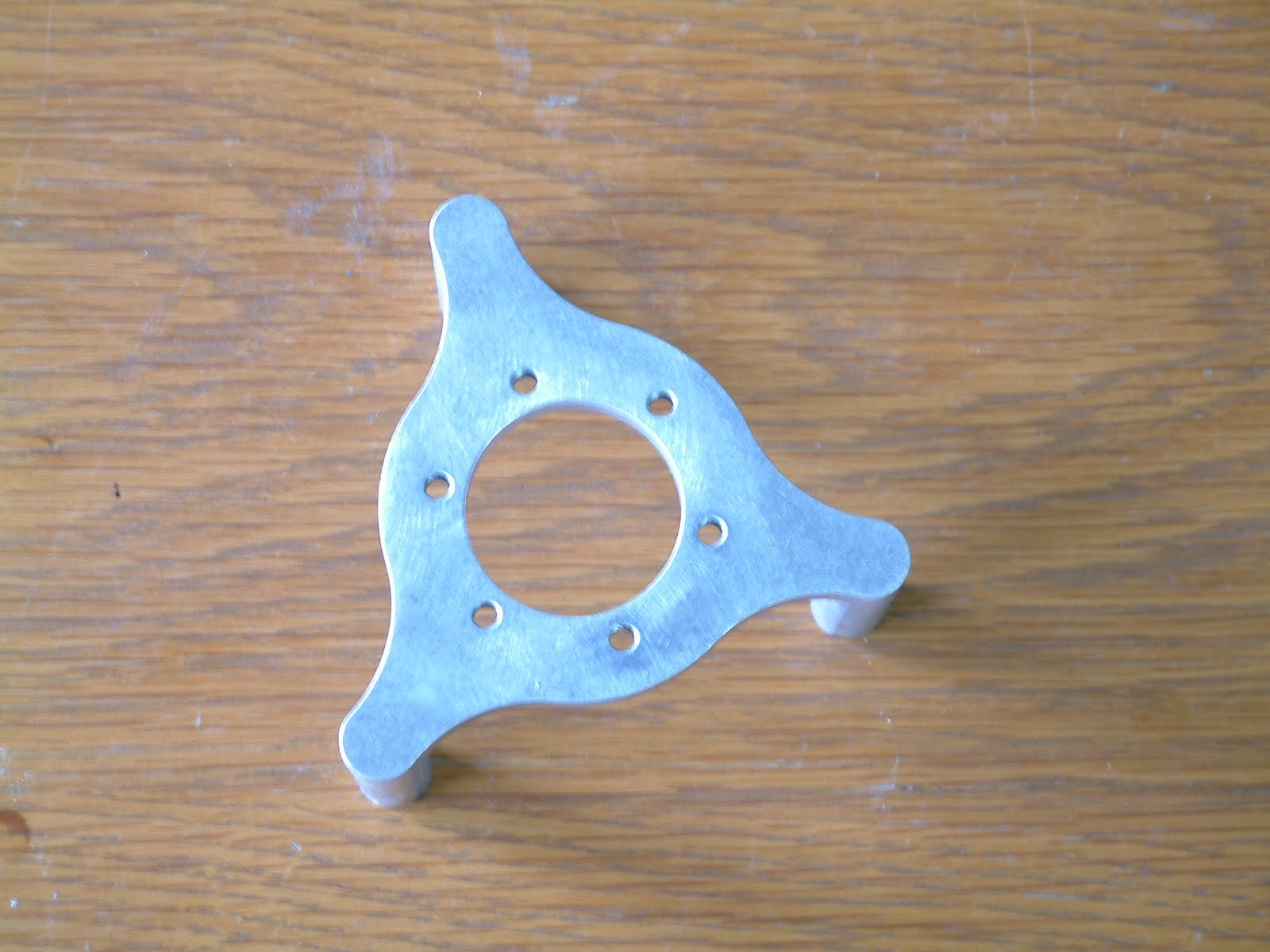
And tonight, I provide just one example:  our new disc brakes, which we are installing on our ready to fly and kit aircraft.  These disc brakes are composed of three major components:  a machined 'tripod' standoff, which works in conjunction with a solid steel 4130 chromalloy axle to attach to the brake rotor and to the wheel; a brake attachment plate, and, of course, a disc brake caliper/rotor assembly, which comes directly from the mountain bike industry as an OEM component.  It works great for our lightweight aircraft.

Here's what the assembled brake looks like (the brake cable is not attached in this photo) (also note the steel spring suspension):


It's a very tight, neat looking arrangement.

The aluminum components are machined from solid billet: 6061T-6, which is a common aircraft alloy.

Let's take a look at each individual component.  Here's the standoff 'tripod':


And here's two more views of the same part:


This 'tripod is used to fix the brake caliper to the wheel.  It's designed to work with our 5 inch wheels, which are now the standard wheel on every Belite aircraft.

Another component is the brake attachment plate.  It's a simple part, and is very strong.  Here it is:


To make all of this work, we do need a disc brake rotor and caliper.  As I mentioned previously, our Part 103 ultralight aircraft are well matched to use a brake from Avid.  Here's the brake:


So let's stack all these parts up and see what it looks like.  You can see the 'Tripod' below the brake rotor:


And let's now put the attachment plate on top:


Obviously a few nuts, bolts, axles, and cables missing.  But hopefully, you get the idea.

Here's one more look at how it ends up on the aircraft landing gear:


Side note:  Look at that nice big fat 5.00 x 5 tire!

We sell these for $350 as a kit and $400 installed on our flyaway airplanes.  The kit includes left and right sides.  (pricing always subject to change without warning.)

You can find them on our Ready To Fly spreadsheet, and also on our Price Your Own Kit spreadsheet.

My thanks to my able assistant Gene Stratton for shooting these pics.

Friday, July 2, 2010

A great trailer for hauling an ultralight aircraft

How do you trailer an ultralight airplane?

A common question concerns trailering our Belite ultralight aircraft.  For long distances, nothing beats a covered trailer.  But for short distances, a boat trailer works great for hauling the aircraft between your home and the airstrip.  You just have to do a little work to make it work perfectly.

My friend, Terry Alley, bought a boat trailer and modified it to haul his Kitfox Lite around.  I recently borrowed his trailer to haul a Superlite from our hangar, over to my Church for a car show.  (And that's another story, how our airplane ended up being the only airplane at a car show.)

Here's a pic which shows the Superlite on the trailer. Note the trailering bar which are attached to the leading edge of the wing, down to the strut attachment point.  (This provides rigidity to the wing, so that it is not damaged while trailering.)  Also note how the ramps have been set at just the correct width to allow the plane to roll backwards and onto the trailer:


Here's a pic of the airplane on the trailer from the side.  Note that the trailer is exactly the correct length, so that the tailwheel is by the ratchet lever:


Here's pic of the aircraft from the front of trailer, looking back.  You can see a gust lock on the elevator/stabilizer on the right side:


The airplane is just a little long for this trailer, so the tailwheel springs have been disconnected, and the tailwheel twisted 180 degrees backwards.  The tailwheel fits into the steel channel which is part of the original trailer.  Note the ratchet drum (which isn't used for anything anymore) and also note the center 'V' channel which Terry mounted on the trailer.  This is for the tailwheel to 'roll up' the trailer as the aircraft is backed onto it.


After the airplane is loaded, the wheel ramps rotate up and are bungeed in place.  This locks the wheels and the aircraft onto the trailer.  Also note the wooden plank across the rear of the trailer.  This was put on the trailer so the aircraft tires would have a solid place to rest.


You can't see it here, but some straps are used on the other side of the wheel to lock the landing gear strut in place, so it can't roll at all.  I also use some extra bungees around the landing gear to the boat trailer, as good redundancy.


In this pic, you can see the red nylon straps.  You can also see our awesome steel spring landing gear on the Belite:


Don't forget to tie the tailwheel to the front of the trailer.

Also, don't forget to install solid gust locks on the rudder and the elevator.

And that's really all there is to it.  Trailering a FAR part 103 ultralight is easy; so is trailering any small experimental aircraft.  I hope this gives you some good ideas on how to make a great, inexpensive trailer for hauling your aircraft around town and out to the airstrip.